

Most companies believe mobile costs spiral because development is slow, complex, or expensive.
That assumption is comforting.
It suggests the problem can be solved with better engineers, more people, or a different framework.
In practice, the real cost of mobile products comes from somewhere else.
It comes from coordination.
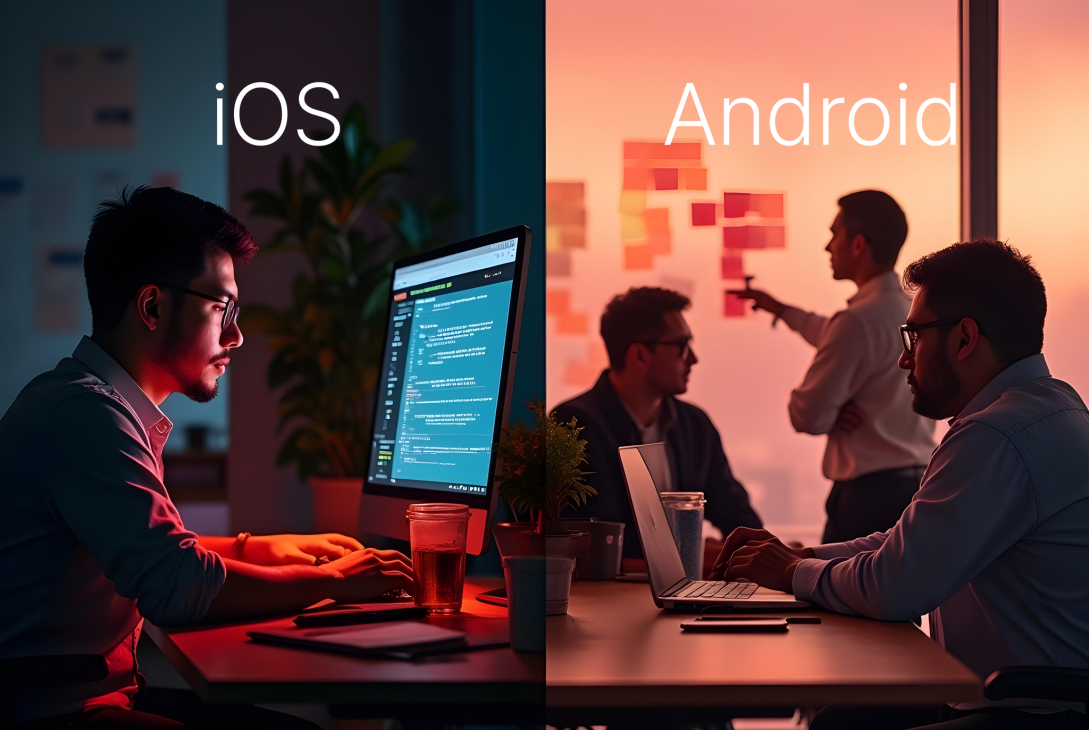
Specifically, from what happens when iOS and Android stop moving as one product and start evolving as two similar but incompatible systems.
This article explains why that divergence is almost inevitable in multi-codebase setups, how it quietly destroys velocity, and why alignment, not raw speed, is what keeps mobile costs under control long term.
The Illusion of Speed in Early Mobile Teams
In the first year, everything looks fine.
Two native teams can move fast:
- Decisions are simple
- The product surface is small
- Everyone knows what everyone else is doing
Shipping the same feature twice does not feel expensive yet.
Duplicating logic still fits inside people’s heads.
This is where many teams conclude that mobile cost is a development problem and that speed is the primary optimization target.
That conclusion only holds while coordination is cheap.
Where Costs Actually Start Compounding
As the product matures, small differences begin to appear.
Not dramatic ones. Subtle ones.
- Slightly different onboarding flows
- Platform-specific interpretations of the same requirement
- Edge cases “handled later” on one platform
- UX exceptions justified as native conventions
Each difference seems reasonable in isolation.
Collectively, they create divergence.
Once that happens, every future decision becomes more expensive:
- Product discussions happen twice
- Estimates drift because assumptions are no longer shared
- Bugs stop being reproducible across platforms
- Feature parity becomes an ongoing negotiation
The codebases are no longer mirrors.
They are cousins.
This is the moment when velocity drops and costs spike, even though the team has more people than before.
The Hidden Tax: Decision Fragmentation
The most expensive part is not duplicated code.
It is duplicated thinking.
When iOS and Android evolve independently:
- Every feature requires two technical validations
- Trade-offs are made in different contexts
- “Done” means different things to different teams
This introduces what we often call a decision tax.
Not visible on invoices.
Very visible on roadmaps.
The product slows down not because engineers are inefficient, but because alignment must be renegotiated continuously.
Why React Native Changes the Cost Curve

React Native does not eliminate complexity.
It constrains where complexity can live.
By default, it forces:
- One product surface
- One shared mental model
- One place where trade-offs must be made explicitly
This has a structural effect on teams.
Divergence becomes visible earlier.
Exceptions become intentional, not accidental.
Product decisions are shared by default, not synchronized later.
The result is not magical speed.
It is controlled complexity.
Alignment as a Long-Term Cost Strategy
In year one, speed feels like the goal.
In year two and three, something else matters more:
- Team growth
- Ownership clarity
- Predictable delivery
This is where alignment starts paying dividends.
A single aligned system:
- Reduces cognitive load across the team
- Keeps estimation meaningful
- Prevents silent forks in behavior and logic
Alignment does not make teams slower.
It prevents speed from becoming expensive.
The Senior Perspective: Why This Matters to the Business

From a business perspective, mobile cost is rarely about frameworks.
It is about:
- How many decisions must be coordinated
- How often context needs to be rebuilt
- How much rework is created by misalignment
Systems that allow divergence without friction accumulate interest.
You pay it later in velocity, morale, and roadmap confidence.
React Native is not a shortcut.
It is a structural bet on alignment.
And alignment is cheaper than speed.
Conclusion
Mobile products do not become expensive because development is hard.
They become expensive because coordination breaks down as the system grows.
Two codebases amplify that risk.
One aligned surface reduces it.
If you care about year two and beyond, optimization is not about shipping faster today.
It is about keeping decisions aligned tomorrow.
Alignment is cheaper than speed.
Call to Conversation
Every mobile team eventually faces this trade-off.
If you are navigating growing mobile complexity and trying to stabilize velocity without exploding costs, it is worth stepping back and examining where divergence is silently accumulating.
That conversation often matters more than the next framework choice.
Last modified: December 30, 2025